 During Pontiac’s early years, it solidified a reputation of being a car for older drivers. Generally Pontiac was known for building reliable, conventional, and sturdy cars for buyers who wanted a car more upscale than a Chevrolet but not as fancy as a Buick or a Cadillac. Pontiacs back then didn’t appeal to younger buyers or buyers who wanted an upscale car. In other words owning a Pontiac then was not for prestige but for functionality. It was the perfect middle-America family car. This all changed in 1955 when Pontiac would make a bold move that would be the catalyst for not only changing its image but its purpose. A decade later Pontiac would become the car brand that younger car enthusiasts wanted to buy.
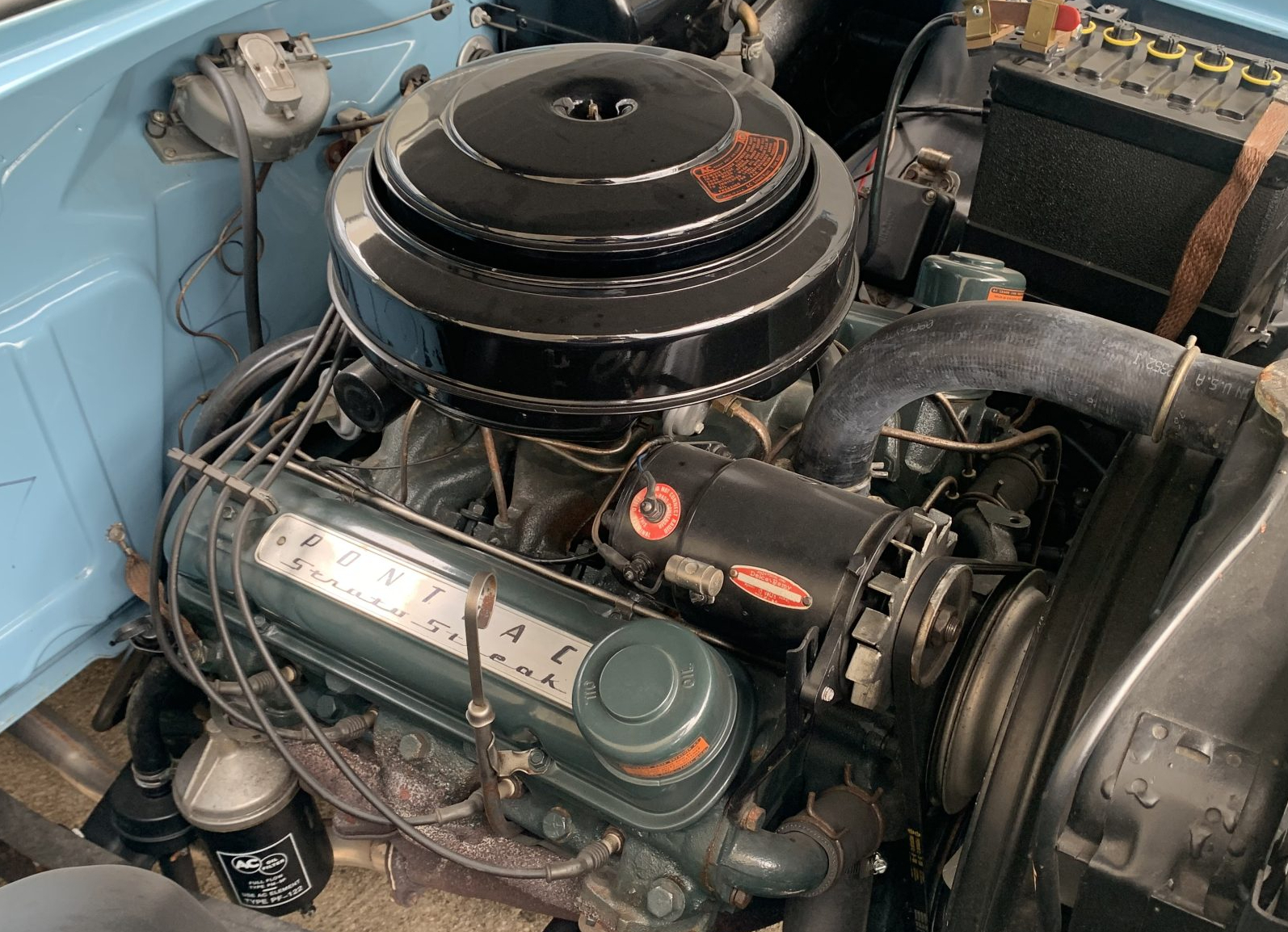
This monumental event was the introduction of Pontiac’s Strato-Streak V8 for the 1955 model year. Since the early-1930s, Pontiac had prided itself on its L-head inline-six cylinder and inline-eight cylinder engines which had a reputation for reliability and longevity. Pontiac understood by the late-1940s that the straight-eight was a  dated engine due to massive popularity of the more modern overhead valve V8. Pontiac was late getting into the V8 game having waiting until the 1955 model year to release its first V8 engine. Many automakers had beat Pontiac to the market by several years. Even though Pontiac’s Strato Streak V8 was late, it was a phenomenal OHV V8 engine. It was a engine design that would last for 25 model years before being cancelled due to Federal emissions regulations and the C.A.F.E. Standards. The Strato Streak V8 architecture would power all of Pontiac’s great muscle cars during the golden era along with many of its other cars.
Not only was the introduction of the 1955 Strato-Streak V8 a game changer but it also changed Pontiac’s mentality and marked the begging of Pontiac’s bold moves which would make it GM’s defacto performance car division a decade later. Pontiac could have made the Strato-Streak V8 the replacement of its inline-eight and kept its inline-six in production. This would have been the safe and conventional strategy. However Pontiac made the bold move of cancelling both its inline-8 and inline-6 engines and made its new Strato-Streak V8 mandatory in all its 1955 and 1956 car models which became a big selling point for these cars. This was something many of the other automakers were too sacred to do.

In the U.S. Market Pontiac only used the Strato-Streak name for its 1955-1956 V8s. The name was dropped starting in 1957. For 1955 the Strato-Streak V8 had 287 cubic-inches of displacement and had an engine bore of 3.75 inches and engine stroke of 3.25-inches. It produced 167 to 200 gross-horsepower depending on configuration. For 1956, Pontiac increased the Strato-Streak V8’s bore to 3.94-inches which bumped up engine displacement to 317 cubic-inches. Engine output was 192 to 285 gross-horsepower depending on configuration. The most performance oriented configuration was the dual 4-barrel carburetor version which produced a mighty impressive for its day, 285 gross-horsepower.

The Strato-Streak V8 used a very innovative reverse engine cooling system, unfortunately this system would only last a few more model years after the Strato-Streak name was retired for 1957. For 1957, Pontiac would increase  its V8’s stroke to 3.56-inches which increased engine displacement to 347 cubic-inches. The Strato-Streak V8 was the start of real performance under the hood of Pontiac’s cars but it has been forgotten over time even though it was a reliable, powerful, and an innovative V8 during it’s short production life. Even though its name was retired its engine design and engine architecture remained and thrived with the same exterior engine dimensions until the end of the 1979 model year where the Trans Am and Firebird Formula were the last Pontiac vehicles to have this Pontiac engine under its hood. At that time it displaced 400 cubic-inches. A shorter deck height and thinner engine wall version of this engine displacing 301 and 265 cubic inches was available until the end of the 1981 model year. Without the Strato-Streak V8 there may not have been a Pontiac GTO, Pontiac Trans Am, and many of the other legendary 1960s and 1970s Pontiac performance cars. The legendary Pontiac performance engines during this era which displaced 326, 350, 389, 400, 421, 428, and 455 cubic-inches, all had the same architecture, design, and exterior dimensions as the Strato-Streak V8. This is why the Strato-Streak V8 was so important.
Click on the link below, to watch the video of this article via Old Car Memories’ YouTube channel:
Written contents in this article – © 2025-2026 Pete Dunton (Old Car Memories) – All Rights Reserved